पिण्ड स्वेदन — औषधीय पोटली से गहन स्वेदन चिकित्सा
Potli Therapy, known classically as Pinda Swedana, is a therapeutic fomentation treatment where heated boluses (potlis) filled with herbs, rice, sand, or other medicated materials are rhythmically massaged over the body. The name derives from Pinda (bolus/bundle) + Swedana (sweating/fomentation) — inducing therapeutic sweat through bundled heat and medicine combined.
The warm potli simultaneously delivers heat therapy (Swedana), medicated oil absorption (Sneha), and the mechanical action of massage — creating a uniquely synergistic treatment unmatched by any single therapy. It is one of the most versatile Ayurvedic treatments, adapting to diverse conditions simply by changing the potli contents.
Charaka states: "Swedana is the primary treatment for stiffness, heaviness, and cold in the body. It liquefies Kapha, pacifies Vata, opens channels, and drives out the disease through sweat." Potli delivers this effect with localised precision and the added benefit of herbal medicines.
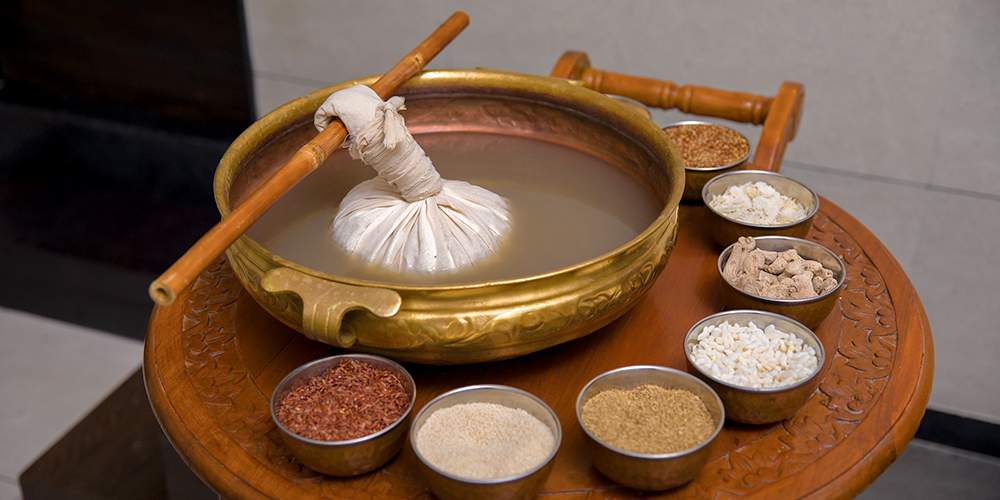
Different bolus preparations for different conditions
Bolus of special Navara rice cooked in milk and herbal decoction. The most nourishing Potli — builds muscle, nourishes nervous tissue, and strengthens the body. Ideal for paralysis, muscular dystrophy, and wasting conditions. Considered Brumhana (nourishing).
Fresh medicinal leaves (Eranda, Nirgundi, Tamarind, Coconut) sautéed in medicated oil, tied in a potli. Most effective for Vata-Kapha joint disorders — arthritis, spondylosis, sciatica. The volatile oils from fresh leaves penetrate deeply into joints and muscles.
Herbal powder bolus — dry medicated powders (Dashmoola, Rasna, Devadaru) mixed with medicated oil and applied hot. Best for Kapha-dominant conditions — obesity, oedema, and conditions needing Lekhana (scraping) action along with heat therapy.
Heated medicated sand in a cloth bundle. Provides dry heat — ideal for conditions where oil is contraindicated (Kapha excess, obesity, certain skin conditions). Excellent for bone and joint pain, lower back stiffness, and conditions requiring Ruksha (dry) Swedana.
Lemon (Jambeera) and herb bolus — lemon halves dipped in medicated oil mixed with grated coconut, turmeric, garlic, and herbs. Exceptional for painful conditions — gout, rheumatoid arthritis, and severe joint inflammation with swelling.
Black gram (Masha/Urad dal) bolus — paste prepared with sesame oil and herbs. Specifically indicated for neurological conditions — facial paralysis, peripheral neuropathy, and hemiplegia. Masha has Vata-pacifying and nerve-nourishing properties.
Potli Therapy's broad therapeutic applications
Osteoarthritis, rheumatoid arthritis, cervical and lumbar spondylosis with pain and stiffness
Lower back pain, disc herniation, sciatica, and chronic spinal stiffness
Fibromyalgia, myalgia, muscle spasms, and post-exercise soreness and fatigue
Paralysis rehabilitation, neuropathy, and peripheral nerve conditions
Sprains, strains, ligament injuries, and post-surgical rehabilitation
Localised fat deposits, cellulite, and Kapha-related weight management
Dry skin, poor complexion, and conditions needing improved skin circulation
Chronic fatigue, burnout, generalised body ache, and psychosomatic conditions
The multi-layered mechanism of therapeutic bolus fomentation
The warm potli raises local tissue temperature by 3–5°C, increasing blood flow, dilating capillaries, relaxing muscle fibres, and dissolving Kapha accumulated in channels. Heat also enhances transdermal absorption of herbal compounds by up to 10-fold compared to room-temperature application.
As the heated potli is pressed and rolled over the body, warm medicated oil impregnated in the potli contents soaks into the skin, penetrating subcutaneous tissue, muscle layers, and joint capsules. This oleation lubricates joints, nourishes muscles, and delivers herbal active compounds to target tissues directly.
The rhythmic pressing, rolling, and tapping of the potli provides mechanical stimulation to muscles, fascia, and marma points. This breaks up adhesions in muscle fibres, stimulates lymphatic drainage, releases trigger points, and improves proprioception — the body's awareness of joint position and movement.
When using fresh herb or lemon potlis, heat activates volatile oils and phytochemicals within the plant material. These aromatic compounds are inhaled during the procedure and also absorbed through the skin — providing anti-inflammatory, analgesic, and calming effects via both olfactory and transdermal pathways simultaneously.
Heat and gentle pressure dilate the Srotas — micro-channels that distribute nutrients to each body cell in Ayurvedic physiology. Opening blocked channels allows Prana (life force) and nutrition to reach deprived tissues. This is how Potli therapy achieves results in paralysis and wasting conditions — reconnecting nourishment pathways to dormant tissues.
Different Potli types target specific dosha imbalances: Navarakizhi nourishes and pacifies Vata (depleted, dry); Patra Pinda reduces Vata-Kapha (stiffness and cold); Churna Pinda addresses Kapha (heaviness, oedema); Jambeera Pinda targets Pitta-Vata (inflammation with stiffness). Prescription precision ensures maximum dosha correction.
A precisely orchestrated healing experience
Our Vaidya begins with a thorough Ayurvedic consultation — Prakriti assessment, Nadi Pariksha, disease history, and identification of the primary doshic imbalance. The affected areas, nature of pain (fixed vs. moving, sharp vs. dull, aggravated by cold or heat), and associated symptoms guide Potli selection. Navarakizhi is chosen for nourishment and nerve conditions; Patra Pinda for joint stiffness; Churna Pinda for oedema and Kapha; Jambeera for acute inflammation; Masha for neurological conditions. Contraindications — acute fever, open wounds, skin infections — are screened before prescription.
Potlis are freshly prepared on the day of each session — never pre-made or reused. For Navarakizhi, Navara rice is cooked fresh in a combination of Dashmoola decoction and cow's milk until reaching the correct consistency, then bundled in cotton cloth. For Patra Pinda, medicinal leaves are freshly collected or sourced, finely chopped, and sautéed in the specific medicated oil prescribed. For Churna Pinda, precise herbal powders are weighed and mixed. Each potli is tested for temperature before application. Fresh preparation ensures maximum potency of volatile compounds and avoids microbial contamination.
A preparatory full-body or localised oil massage (Abhyanga) with the appropriate medicated oil is performed for 15–20 minutes before the Potli application. This Poorvakarma step is not optional — it opens the pores, relaxes muscles, lubricates joints, and prepares the tissue to receive the Potli's heat and herbal compounds more deeply. Without pre-massage, heat penetration is significantly reduced. The massage follows classical downward strokes for Vata conditions and upward strokes for Kapha conditions. Two therapists often work simultaneously for full-body Potli sessions.
Potlis are heated in a pan of warm medicated oil (for wet Potli types) or steam (for dry Potli types) and maintained at 42–48°C throughout the procedure. The therapist continuously alternates between 2–3 potlis, reheating each in the warming vessel as needed to maintain consistent therapeutic temperature. The potli is applied using rhythmic, flowing movements — pressing, rolling, tapping, and gliding — with the pace and pressure adjusted to the patient's tolerance and condition severity. Duration is 45–60 minutes for full body, 30 minutes for localised treatment. Temperature is checked on the therapist's forearm before each application.
After the Potli session, the patient rests wrapped in warm towels for 15–20 minutes, allowing residual herbal compounds to continue absorbing and the body to cool gradually. A warm herbal bath or gentle wipe-down follows — never cold water immediately after, as sudden temperature change negates the therapeutic effects of Swedana. For Navarakizhi, the rice paste that adheres to the skin is gently massaged in before wiping, providing additional nourishment. Rest for 30 minutes post-therapy is advised before resuming activities. Post-therapy snacks (warm, light, easily digestible) are provided to replenish energy.
For acute conditions like sports injuries or acute back pain, 3–5 consecutive daily sessions typically provide significant relief. Chronic arthritis and spondylosis benefit from 7–14 daily sessions. Paralysis rehabilitation requires 21–28 days of daily Navarakizhi combined with other Panchakarma therapies. Maintenance courses of 7 days every 3 months prevent recurrence of chronic conditions. Internal medicines are prescribed alongside the Potli course — analgesics for pain, Vata-pacifying formulations for neurological conditions, and Rasayanas for nourishment. Home care instructions including self-oil massage and dietary guidelines extend the therapeutic benefits between clinic visits.
Targeted approaches for different body areas and conditions
Targeted application along the entire spine — cervical, thoracic, and lumbar regions. Patra Pinda or Churna Pinda used for maximum penetration into vertebral joints.
Localised application around the knee joint for osteoarthritis, ligament injuries, and post-knee surgery care. Jambeera or Patra Pinda preferred for maximum anti-inflammatory effect.
Full-body Navarakizhi for paralysis and neurological conditions. Two therapists apply rice boluses simultaneously for 60 minutes daily over a 21-day course.
Churna Pinda with Lekhana (fat-scraping) herbs like Triphala, Musta, and Trikatu. Applied with upward strokes over fatty areas to stimulate lymphatic drainage and fat metabolism.
Patra Pinda with Mahanarayan oil for athletes. Applied to specific injured muscle groups or joints for rapid recovery, pain relief, and return to training.
Gentle small potli of Masha and cooling herbs for facial conditions — Bell's palsy, trigeminal neuralgia, and facial rejuvenation. Applied with utmost care around the delicate facial area.
Heat, herbs, and healing hands — the perfect therapeutic trinity
Heat and herbal analgesics provide immediate pain relief within the first session. Sustained heat application raises the pain threshold and reduces muscle guarding, providing lasting comfort beyond the session.
Heat loosens stiff muscles and joint capsules, increasing range of motion significantly. Patients with frozen shoulder, stiff knees, and rigid spine experience measurable improvement in flexibility after each session.
Navarakizhi deeply nourishes muscle tissue, prevents atrophy, and builds muscle strength in wasting conditions. Unmatched for paralysis rehabilitation — visible increase in muscle bulk after 21-day courses.
Vasodilation from heat dramatically improves local blood and lymphatic flow. Reduces oedema, improves tissue oxygenation, and accelerates removal of inflammatory metabolites from affected areas.
The combination of medicated oils and heat deeply nourishes skin, improves elasticity, reduces dryness, enhances complexion, and activates skin's natural repair mechanisms for visible rejuvenation.
The combination of warmth, aromatherapy from herbal potlis, and therapeutic touch induces profound relaxation. Cortisol reduction and endorphin release provide lasting mental calm and restored energy.
Nature's healing ingredients in every bolus
(Vitex negundo)
The premier pain-relieving leaf for Patra Pinda Potli. Powerful Vata-Kapha pacifier — reduces joint swelling, relieves nerve pain, and relaxes muscle spasms. Fresh leaves release potent volatile analgesic oils when heated.
(Citrus limon — Lemon)
Used in Jambeera Pinda Sweda. Citric acid and vitamin C in lemon combined with heat provide excellent anti-inflammatory and analgesic action for acute joint inflammation, gout attacks, and rheumatoid flares.
(Oryza sativa var. navara)
A rare medicinal variety of rice used exclusively in Navarakizhi. Rich in protein, antioxidants, and nourishing compounds. When cooked in milk and Dashmoola, creates an unparalleled muscle-nourishing and nerve-regenerating Potli medium.
(Ricinus communis)
Castor leaves in Patra Pinda Potli provide exceptional Vata-pacifying and anti-inflammatory effects. Ricinoleic acid in castor penetrates deeply into joint tissue, reducing inflammation in arthritis, spondylosis, and spinal conditions effectively.
Support your healing with the right foods
Book your session today — warm herbs, skilled hands, and lasting relief await you